
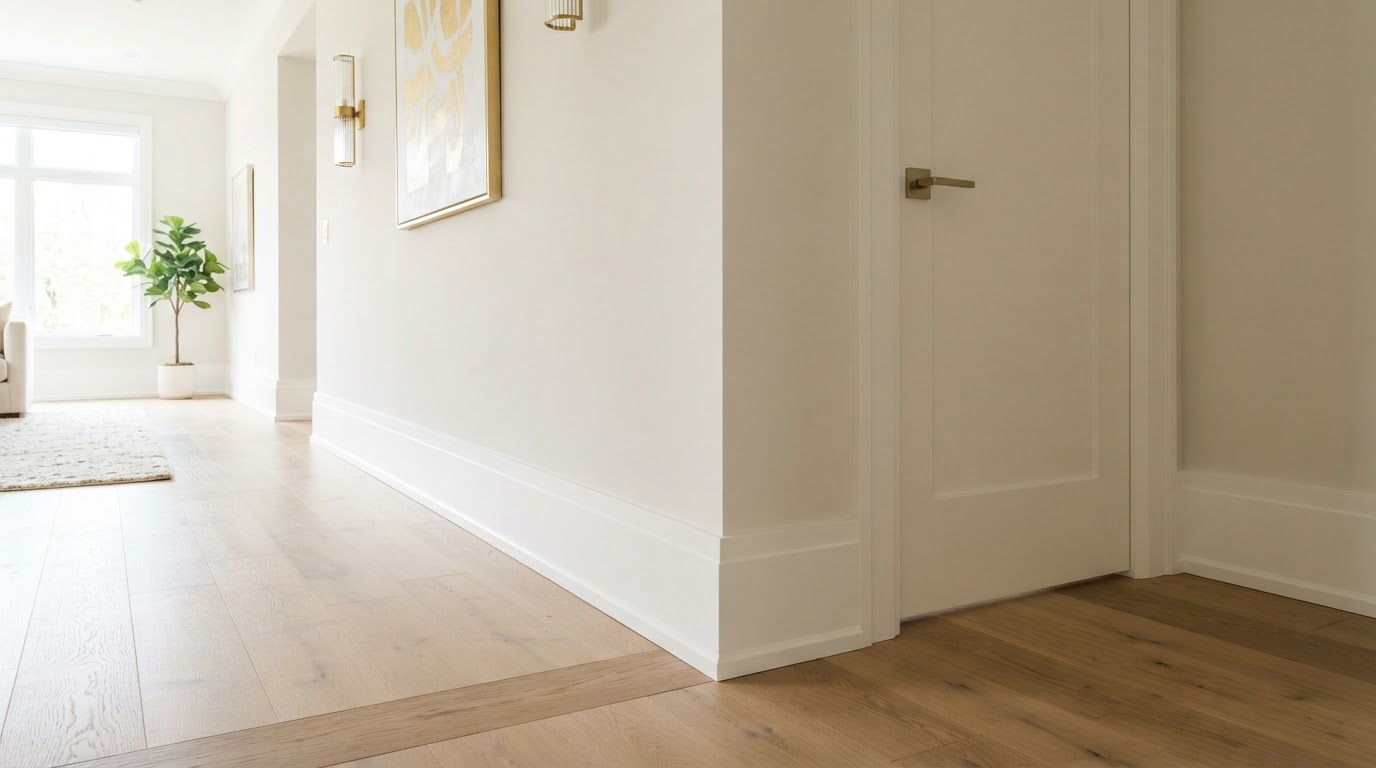
MDF vs. Solid Wood for Trim & Accent Walls DFW
Is MDF or Solid Wood Better for Interior Trim & Accent Walls?
MDF can provide a smooth, consistent paint-grade surface suitable for many decorative interior applications. Solid wood offers natural grain, staining possibilities, and distinct mechanical characteristics, but requires appropriate consideration of species, wood movement, installation, and cost. The best choice depends on the application, room conditions, desired finish, structural demands, and budget — neither material is universally superior.
MDF vs. Solid Wood for Baseboards, Wainscoting & Custom Accent Walls
A balanced comparison of material properties, appearance, and performance for architectural woodwork.
| Feature | MDF | Solid Wood |
|---|---|---|
| Material Composition | Engineered wood fibers, resin | Natural wood, single species |
| Paintability | Excellent — smooth, no grain | Good — grain may telegraph |
| Stainability | No — no wood grain | Excellent — natural grain |
| Appearance | Uniform, smooth, painted | Natural grain, stain or paint |
| Dimensional Behavior | Stable, minimal warping | Expands/contracts with humidity |
| Moisture Sensitivity | High — swells at edges | Moderate — warps, cups, checks |
| Impact Resistance | Lower — dents at edges | Higher — resists impact |
| Fastener Performance | Moderate — may split, use pilot holes | Good — holds fasteners well |
| Machining | Clean cuts, no splintering | Good — may splinter or tear |
| Repairability | Difficult — damaged areas hard to fix | Good — can sand, fill, refinish |
| Maintenance | Low — painted surface | Low–Moderate — may need refinishing |
| Material Cost | Generally lower | Generally higher |
| Appropriate Applications | Painted trim, paneling, battens | Stain-grade, structural, high-impact |
Plywood and finger-jointed wood are additional material options, not simply other names for MDF or solid wood. Cabinet-grade plywood is common for cabinet boxes, while finger-jointed wood trim offers paint-grade economy with solid wood characteristics.
Ready to discuss your Plano project?
Our in-house design team and finish carpentry craftsmen are ready to scope your vision with a free consultation.
MDF and Wood Durability, Moisture Exposure & Finish Quality
Understanding how each material behaves in real-world conditions prevents costly mistakes.
Interior Humidity
Affects wood movement.
Wood Expansion & Contraction
Seasonal dimensional change.
MDF Dimensional Behavior
Stable but moisture-sensitive.
Moisture-Related Swelling
MDF edges absorb water.
Solid Wood Species
Poplar, oak, maple differ.
Surface Dents
MDF edges vulnerable.
Edge Durability
Wood holds up better.
Paint Finish Smoothness
MDF excels for painted trim.
Stain-Grade Wood
Natural grain appearance.
Fastening
Pilot holes recommended for MDF.
Material Thickness
Affects profile and strength.
Trim Profiles
Available in both materials.
Crown Molding Installation
Both materials used.
Baseboard Replacement
Wood for high-traffic, MDF for painted.
Bathroom Trim Selection
Moisture-resistant options.
Wall Panel Applications
MDF common for painted panels.
Shelf Loading
Solid wood or plywood for spans.
Cabinet Construction
Plywood boxes, MDF/wood faces.
Proper Sealing
Critical for moisture protection.
Repairs
Wood easier to repair than MDF.
Emissions Certification
TSCA Title VI compliance.
Standard MDF may be vulnerable to moisture-related damage and requires careful application selection. Moisture-resistant MDF is not automatically waterproof. Solid wood also responds to moisture and may expand, contract, or distort under changing conditions. Appropriate design, product selection, installation, and finishing are essential for both materials.
Composite Wood Product Standards & Architectural Woodwork References
Regulated MDF and other covered composite wood products are subject to U.S. EPA TSCA Title VI formaldehyde emission standards. This does not imply all MDF is unsafe or that all solid wood products are free from finishing or adhesive-related emissions.
Choosing MDF or Solid Wood for Plano Finish Carpentry & Accent Walls
Different interior projects benefit from different material selections — and sometimes a combination of both.
- Board and batten — MDF battens for smooth painted finish.
- Wainscoting — MDF for painted panels, wood for stain-grade.
- Picture frame molding — MDF or poplar for painted trim.
- Crown molding — MDF for painted, wood for stain-grade.
- Baseboards — wood for high-traffic, MDF for painted.
- Door casing — both materials appropriate.
- Wood slat walls — solid wood or veneered panels.
- Custom built-ins — plywood boxes, MDF/wood faces.
- Bookshelves — solid wood or plywood for shelf spans.
- Bathrooms & mudrooms — moisture-resistant options.
- Luxury stain-grade millwork — solid wood required.
Painted architectural trim often benefits from MDF's smooth finish, while solid wood or engineered structural products may be more suitable for shelving, cabinetry, and high-impact areas. Selecting different materials for different components of the same project often produces the best combination of appearance, performance, and value.
MDF vs. Solid Wood Trim & Accent Wall Questions
Direct answers on board and batten, baseboards, moisture, staining, and TSCA compliance.
Bring Your Vision to Life With Lively Luxury Designs
Serving Plano, Collin County, nearby Dallas County communities, and the greater Dallas–Fort Worth area. Request a free consultation or call our Plano studio directly.