
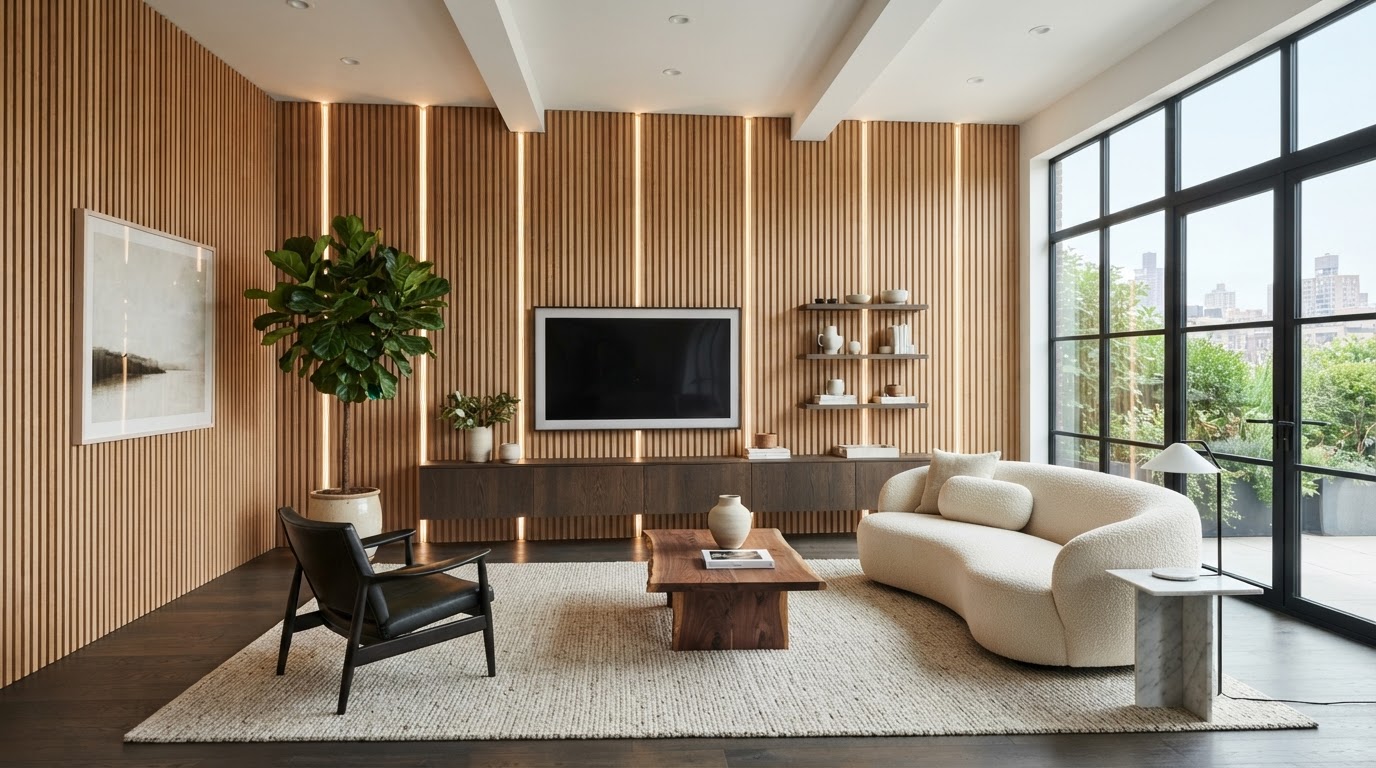
Wood Slat Walls vs. Acoustic Panels DFW
What Is the Difference Between Wood Slat Walls & Acoustic Panels?
Decorative wood slat walls primarily provide architectural texture, visual depth, and a distinctive interior finish. Acoustic panels are designed to absorb or otherwise manage sound energy, with performance depending on materials, construction, placement, and tested installation conditions. Some wood slat panel systems incorporate acoustic backing and can provide both visual appeal and sound absorption — but not all decorative wood slat walls are acoustic panels, and not all acoustic panels contain wood slats. This guide explains the technical and design differences so you can choose the right product.
Decorative Wood Slats vs. Felt-Backed & Fabric-Wrapped Acoustic Panels
Visually similar products may serve very different performance goals. This comparison clarifies the distinctions.
| Feature | Decorative Wood Slats | Acoustic Slat Panels | Fabric/Felt Acoustic Panels |
|---|---|---|---|
| Primary Function | Architectural texture and visual depth | Visual appeal + sound absorption | Sound absorption and echo reduction |
| Visual Appearance | Natural wood grain, vertical slats | Wood slats over felt backing | Fabric or felt surface, flat panels |
| Common Materials | Solid wood, veneered slats | Wood slats + PET felt backing | Fabric-wrapped fiberglass, PET felt |
| Sound Absorption Potential | Low (without backing) | Moderate–High (with backing) | High (purpose-built) |
| NRC Data Availability | Usually not provided | Often provided by manufacturer | Typically provided and tested |
| Typical Installation | Furring strips, direct mount | Mounting tracks, felt backing | Direct mount, adhesive, or impaling clips |
| Room Applications | Accent walls, bedrooms, living rooms | Offices, media rooms, living spaces | Theaters, conference rooms, studios |
| Thickness & Mounting | Slats on furring, varies | Slats + felt, air gap affects performance | 1–4 inches, air gap improves absorption |
| Maintenance | Dusting between slats | Dusting slats, vacuum felt | Vacuum fabric, spot clean felt |
| Relative Cost Drivers | Wood species, slat count, wall area | Panel system, felt quality, coverage | Panel count, thickness, fabric grade |
Visually similar products may be designed for different performance goals. A decorative wood slat wall without acoustic backing provides limited sound absorption, while a felt-backed slat system or fabric-wrapped panel is engineered for measured acoustic performance. Always refer to manufacturer test reports for specific product claims.
Ready to discuss your Plano project?
Our in-house design team and finish carpentry craftsmen are ready to scope your vision with a free consultation.
Acoustic Ratings, Reverberation & Soundproofing Differences
Understanding the technical distinctions prevents confusion between absorption, isolation, and soundproofing.
Sound Absorption
Reducing echo within a room.
Reverberation
Lingering sound after the source stops.
Echo
Reflected sound that degrades clarity.
Speech Clarity
Improved by absorption treatment.
NRC Rating
Absorption coefficient, 0 to 1.
SAA Rating
Sound Absorption Average, similar to NRC.
Frequency-Dependent Absorption
Performance varies by frequency.
Panel Thickness
Thicker panels absorb lower frequencies.
Felt or Absorptive Backing
Key to slat panel performance.
Air Gaps
Air space behind panels improves absorption.
Slat Spacing
Affects how sound reaches the backing.
Mounting Configuration
Affects tested performance.
Wall Coverage
More coverage means more absorption.
Manufacturer Test Reports
Verify specific product claims.
ASTM C423 Test Methods
Standard absorption testing.
STC (Sound Transmission Class)
Measures isolation, not absorption.
Sound Isolation
Preventing sound transfer between rooms.
Mechanical & Airborne Noise
Different transmission paths.
NRC measures sound absorption characteristics of tested products or assemblies, while STC is associated with sound transmission through building assemblies. Sound-absorbing panels do not automatically prevent noise from moving between rooms. Performance depends on the actual complete panel system — backing, air gap, mounting, and coverage — not simply the presence of wood slats. Do not invent acoustic ratings, test results, or decibel reductions; refer to manufacturer test reports for specific claims.
Wood Slat & Acoustic Panel Applications for Plano Homes and Offices
Choosing the right product depends on whether visual appeal or measured sound absorption is the primary goal.
- Luxury living rooms — decorative wood slats for architectural texture.
- Bedrooms — slat accent walls for warmth and visual depth.
- Home offices — acoustic panels to improve video call clarity.
- Video conferencing rooms — felt-backed slats for both look and sound.
- Home theaters — fabric-wrapped panels for measured absorption.
- Media rooms — combine slat walls with separate acoustic treatment.
- Corporate offices — acoustic panels for conference rooms.
- Commercial spaces — reception and restaurant acoustic treatment.
When visual architectural appeal is the primary goal, decorative wood slats may suffice. When measured sound absorption should influence material selection, choose felt-backed slat systems or fabric-wrapped panels with published NRC data. Combining decorative slat walls with separate acoustic treatments is a practical approach when both visual and acoustic goals must be met.
Wood Slat Wall vs. Acoustic Panel Questions
Direct answers on sound absorption, NRC ratings, soundproofing, and product selection.
Refer to manufacturer acoustic test reports for specific product performance claims.
Bring Your Vision to Life With Lively Luxury Designs
Serving Plano, Collin County, nearby Dallas County communities, and the greater Dallas–Fort Worth area. Request a free consultation or call our Plano studio directly.